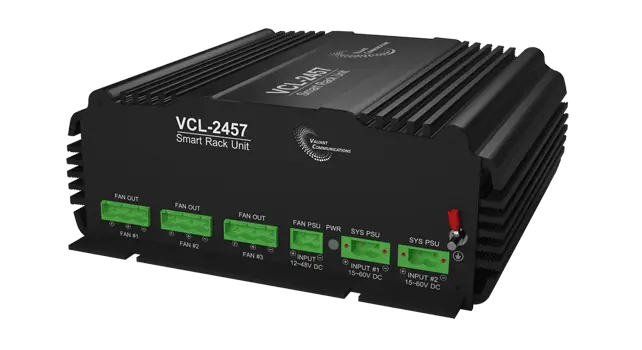
This unit not only assists in conserving power by selectively switching off the rack's cooling fans according to the
prevailing temperature conditions in the equipment rack but also greatly increases the life span (MTBF) of the fans because fans are switched
off when they are not required to operate while always maintaining the rack ambient temperature at the user-desired levels.
As a rule, all fan units have a “life cycle” that is specified by its manufacturer and stated in “number of operating
hours,” after which the fans become increasingly susceptible to failure. The VCL-2457 Smart-Rack Management and Fan Control Unit monitors the
user-set RPM thresholds of each fan unit to track their RPM and forewarns the users of a fan failure or even its impending failure. In the
event of a fan failure, or if its RPM falls below a user-set threshold (which could occur due to a “faulty fan rotor bearing” or a
“choked” air filter), the VCL-2457 triggers its alarm relay (which may be connected to an external Logic, Audio, or Visual alarm) to alert the
administrator. The VCL-2457 also generates an “alarm” message, which is transmitted to the administrator as an Ethernet string containing all
the vital information of the rack to a remote PC over an IP link through its Ethernet interface. All events and alarms are accurately time-stamped
since the VCL-2457, Smart-Rack Management, and Fan Control Unit can be synchronized to an external (remote) NTP/SNTP server for accurate time
and date synchronization.
Even when the fans are not in use, the VCL-2457 Smart-Rack Management and Fan Control Unit is designed to “test and prime”
the fans once every 24 hours by switching them “on” for a short duration to ensure that the fans always remain operational at their optimum speeds.
Such a feature ensures that all fans are exercised periodically and shall function normally, without fail, whenever required by the rack's changing
ambient conditions. The VCL-2457 Smart-Rack Management and Fan Control Unit not only becomes an important tool to improve the operating efficiency
of an electronic equipment rack but also assists in providing preventive maintenance and enhancing the operating life of the equipment that is
installed in the rack by maintaining an optimum operating environment.